
The Cold Lead Is Not a Dead Lead: A Documented Re-Engagement System for Multifamily Leasing Teams
Why Cold Leads Go Cold in 2026
In a tighter market, cold leads were an anomaly. In 2026, they are the norm.
Canada’s national purpose-built rental vacancy rate rose to 3.1% in 2025 — up from 2.2% the year before. In Calgary specifically, renter engagement on major platforms softened in Q4 2025: page views fell 26% year-over-year, saved searches declined 22%, and favourited listings dropped 19%. Renters have more options, more time, and less urgency than they did 18 months ago. (Source: CMHC 2025; RentCafe Canada Q4 2025)
This means your leasing team will encounter more cold leads — not because of poor marketing, but because market conditions have shifted the decision timeline. The question is whether your team has a documented system for what happens when a lead goes quiet, or whether re-engagement lives in someone’s head and varies by who is working that shift.
A lead goes cold for predictable reasons:
- They are still comparing options and have not yet reached a decision point
- They have an unaddressed concern that was never surfaced
- They do not yet see enough differentiation in your offering to act
- The initial contact was too early in their timeline
- They simply got busy and the follow-up stopped
None of these are permanent states. All of them are addressable — if your team has a structured, sequenced re-engagement protocol with proof requirements at every stage.
The PCG Re-Engagement Framework
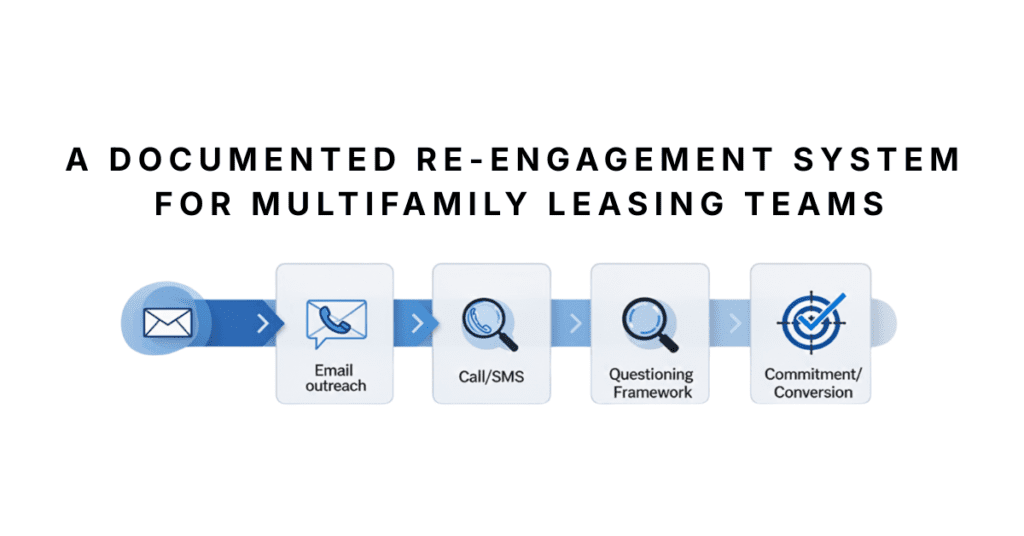
The following is the documented sequence PCG installs as part of our leasing execution programs. Every step has a defined timeline, a proof requirement, and a clear next action. A lead cannot be marked as a re-engagement attempt unless the action is logged in the CRM with a timestamp and a documented response — or documented non-response. No Proof = No Credit = No Stage Advancement.
Step 1: Understand What Kind of Cold Lead You Have
Before any outreach, the leasing agent must categorize the lead based on available data. This is not guesswork — it is a documented assessment that informs which sequence gets triggered.
Category A — Early stage, low intent: Filled out a form, never responded to initial outreach. No tour scheduled.
Category B — Mid-funnel dropout: Toured or engaged meaningfully, then went quiet. Had a specific concern that was not fully resolved.
Category C — Timing-driven cold: Was engaged, communicated a future timeline (“checking for March”), and has not re-engaged at the expected time.
The re-engagement sequence, messaging, and questioning approach differ by category. Treating all cold leads identically is the most common system failure we see in leasing operations.
Step 2: The Initial Re-Engagement Outreach Sequence
SLA: First re-engagement attempt within 72 hours of lead going cold. All attempts logged with timestamp in CRM.
Email 1 — The Soft Re-Entry (Day 1)
Purpose: Re-establish contact without pressure. Acknowledge the gap, offer a practical resource.
Subject: Still exploring your options?
Hi [First Name],
We noticed some time has passed since you first reached out. That is completely normal — finding the right home takes time and the decision deserves careful thought.
If you have questions that were not answered the first time, or if your situation has changed, we would be glad to pick up the conversation wherever makes sense for you.
Is there anything specific that would be helpful right now?
[Agent Name] | [Property Name]
What this accomplishes: Opens a door without assuming the lead is still in active search. The open-ended question invites a response without pressure and surfaces any unresolved concerns.
Email 2 — Add Documented Value (Day 4 if no response)
Purpose: Provide something genuinely useful. Not a promotional offer — a resource that helps them make a better decision regardless of whether they choose your property.
Subject: Something that might help with your search
Hi [First Name],
Making a decision on a new home involves a lot of moving parts. To make your search a little easier, I wanted to share [a virtual tour / a current floor plan availability update / a breakdown of what’s included in your monthly rent with no hidden fees].
No pressure — this is just information I thought would be useful whether you’re still considering us or comparing options elsewhere.
[Resource link or attachment]
I am here if you have questions.
[Agent Name] | [Property Name]
What this accomplishes: Positions the leasing agent as a resource rather than a closer. Addresses the most common reason leads go cold in 2026 — fee ambiguity and lack of transparent information. Note: the resource shared must be accurate, complete, and current. Sending outdated availability or incorrect pricing information at this stage kills the re-engagement before it starts.
Phone Call 1 — Warm Check-In (Day 5–6 if no email response)
Purpose: Human contact. Not a pitch — a genuine inquiry into where they are.
Script:
“Hi [First Name], this is [Name] from [Property]. I wanted to follow up on the note I sent a few days ago. I’m not calling to push anything — I just wanted to make sure you had everything you needed from us. Is there anything I can help clarify, or has your timeline shifted?”
If they answer: Move immediately into the questioning sequence in Step 3.
If no answer: Leave a brief voicemail, log the attempt with timestamp, and move to SMS.
SMS — Brief and Direct (Day 7 if no response to calls or emails)
Hi [First Name], this is [Name] from [Property]. Just checking in — happy to answer any questions when the timing works for you. No rush at all.
Note on SMS: SMS has the highest open rate of any channel. Keep it to two sentences maximum. No promotional language. No urgency pressure. The purpose is to surface whether the lead is still reachable — not to close.
Step 3: The Questioning Framework — Surfacing the Real Reason
When a cold lead does re-engage — whether by email reply, returning a call, or responding to SMS — the conversation that follows determines whether they convert. The most common failure at this stage is the leasing agent defaulting to a sales pitch rather than a structured questioning sequence.
The PCG questioning framework is built around one principle: you cannot solve a concern you have not surfaced. Every question is designed to draw out the real blocker — whether it is practical (pricing, timing, unit availability) or something harder to name (uncertainty about the decision, concerns about the community, a previous bad experience with a leasing team).
Question Type 1 — Open Discovery
Purpose: Get the prospect talking. Understand what is actually driving their search and what has not been addressed.
- “What is the most important thing you are looking for in your next home?”
- “When you first reached out, what drew you to this property specifically?”
- “If you could change one thing about where you are living now, what would it be?”
- “How do you envision the space fitting into your day-to-day routine?”
What to listen for: The answer to these questions almost always contains the real objection. If someone says “I need a quiet building,” they have likely had a bad experience somewhere else. If they say “I need to understand all the costs upfront,” fee transparency is the issue. Log the response in the CRM immediately — it informs every subsequent touchpoint.
Question Type 2 — Clarifying the Concern
Purpose: When a concern has been mentioned — directly or indirectly — go deeper before attempting to resolve it.
- “You mentioned budget was a factor — what are you comparing this against?”
- “What specifically has not been addressed yet that would help you move forward?”
- “What would need to be different for this to feel like the right fit?”
- “I sense there is some hesitation — can you help me understand what is driving that?”
The critical rule here: Do not answer a concern before you fully understand it. A prospect who says “it feels expensive” may mean the rent is above their budget, may mean they do not understand what is included, or may mean they toured a competing property with a better incentive package. These require completely different responses. Clarify before you respond.
Question Type 3 — Building Trust Through Reflection
Purpose: Demonstrate that you are listening, not selling. Reflecting back what a prospect has said builds the trust required for them to share the real blocker.
- “It sounds like having in-suite laundry is non-negotiable for you — is that right?”
- “I hear you saying flexibility on the move-in date is important. What timeline are you working with?”
- “You mentioned you want to feel part of a community — what has that looked like in places you have lived before?”
Why this matters operationally: Reflective questions are not soft skills — they are a documented part of the re-engagement sequence because they prevent the most expensive leasing mistake: offering solutions to problems the prospect does not actually have. A leasing agent who leads with “we have a rooftop terrace and a gym” to a prospect whose real concern is noise levels has wasted both parties’ time and confirmed to the prospect that the team is not listening.
Question Type 4 — Creating Vision
Purpose: Help the prospect connect emotionally to the space. This is particularly effective for Category B leads (toured, went quiet) because they have already seen the property.
- “When you walked through the suite, was there a moment where you could picture yourself living there?”
- “If you moved in next month, what would a typical morning look like for you here?”
- “What would change about your day-to-day if this was your space?”
Use these sparingly and only after you have surfaced the real concern. Vision questions asked before trust is established feel manipulative. Asked after a prospect feels genuinely heard, they are a natural bridge to commitment.
Question Type 5 — Commitment and Next Step
Purpose: Confirm readiness and establish a concrete next action. The next action must be specific — not “I’ll follow up with you” but a defined date, time, and action.
- “What would it take for you to feel comfortable taking the next step?”
- “If we could address [specific concern], would you be ready to move forward?”
- “Is there anything standing between you and scheduling a tour this week?”
- “What would make you feel confident this is the right decision?”
The proof requirement: Every commitment question that results in a next step must be logged in the CRM with the specific action, the date agreed, and the agent responsible. If the prospect says “call me Thursday,” that is a scheduled task — not a note in an email thread.
Question Type 6 — Soft Close for Hesitant Leads
Purpose: For leads that are re-engaging but not yet ready to commit, reduce the size of the ask.
- “Would you be open to a quick virtual tour so you can see the space again without committing to anything?”
- “What if we held the unit for 24 hours while you think it over?”
- “Is there someone else involved in the decision who would benefit from seeing the property?”
Step 4: The Behaviour-Triggered Follow-Up Sequence
Once your CRM is correctly configured, re-engagement outreach should be triggered by prospect behaviour — not by calendar reminders or agent memory. This is the difference between a leasing team that reacts and a leasing team that operates with a governed system.
| Trigger | Action | Timeline |
|---|---|---|
| Form submitted, no response | Email 1 → Email 2 → Call → SMS | Days 1, 4, 5–6, 7 |
| Email opened, no click | Follow-up email with specific resource | Within 48 hours |
| Link clicked, no tour booked | Phone call + follow-up email | Within 24 hours |
| Tour scheduled, no-show | SMS within 2 hours + reschedule email within 24 hours | Same day |
| Tour completed, gone quiet | Re-engagement sequence starts Day 3 | Days 3, 7, 14 |
| Category C lead reaching timeline | Proactive outreach referencing their stated timeline | Day of or day before |
The no-show protocol specifically: Contact within two hours of the missed appointment. Not the next day. The first two hours after a no-show are when the prospect is most likely to respond — they know they missed it and they are still thinking about it. A same-day text that says “Sorry we missed you — is there a better time this week?” converts at a significantly higher rate than an email sent the following morning.
Step 5: The Three-Week Cold Lead Sequence
For leads that have been silent for more than two weeks despite initial outreach, a structured three-week re-engagement sequence is the documented standard. After three weeks and no response across all channels, the lead moves to a low-frequency nurture cadence — not deleted, not closed, but deprioritized with automated monthly touches until they re-engage or opt out.
Week 1 — Re-entry
Subject: Still looking for the right fit?
Acknowledge time has passed. Ask a single open-ended question: “Has anything changed in your search since we last connected?”
Week 2 — New information
Subject: What’s new at [Property Name]
Share a genuine update — a new unit availability, a community event, an updated amenity, or a market context note relevant to their decision. Not a promotional offer. Something informative.
Week 3 — Direct and respectful close
Subject: Last note from us for now
Be honest. “I do not want to keep reaching out if the timing is not right. If you are still exploring your options down the road, we would love to hear from you. I will move you to our occasional updates list unless I hear otherwise.”
This final email consistently generates a higher response rate than weeks one or two — because it is honest, it respects the prospect’s time, and it creates a clear fork in the road.
What This System Requires to Work
The re-engagement framework above is not effective as a set of guidelines distributed in a team meeting. It works when it is installed as a governed operational system with three non-negotiable components:
1. CRM configuration with behaviour triggers Every touchpoint in the sequence must be triggered automatically by lead behaviour — not by agent memory. Your CRM, regardless of platform, must be configured with the workflow logic that initiates each step based on the defined trigger. If it is not in the system, it does not happen consistently.
2. Proof requirements at every stage Every outreach attempt is logged with a timestamp. Every response — including non-response — is documented. Pipeline stage advancement requires proof that the sequence was executed. This is the System Spine principle applied to re-engagement: No Proof = No Credit = No Stage Advancement.
3. Manager QA on re-engagement compliance Weekly QA sampling should include a review of cold lead re-engagement execution. Are the timelines being met? Are the questions being logged? Are no-shows being contacted within two hours? Managers cannot coach what they cannot see — and they cannot see it if the proof is not in the CRM.
The Gap That Costs the Most
Cold lead re-engagement is where the investment in digital marketing either compounds or evaporates. Your marketing budget generated the inquiry. The website captured the contact. What happens over the next three weeks determines whether that investment converts.
Most leasing teams have good intentions and inconsistent execution. The agent on Tuesday follows up immediately. The agent on Friday lets it sit until Monday. Neither is wrong — they just do not have a system that holds the standard regardless of who is on shift.
That is not a training problem. It is an infrastructure problem.
If you want to know where your re-engagement execution is breaking down — we can show you in a 30-minute audit conversation.

Carrie has spent over a decade inside multifamily leasing operations. Every framework she has built started the same way: inside the operation, documenting what actually happens versus what gets reported.